Crete (Heraklion) weather in January
Every figure on this page is for Heraklion, on the north coast of Crete; other parts of the island can differ — the south coast facing Africa is often warmer and drier, and the White Mountains and Mount Ida (Psiloritis) rise to over 2,400 m and hold snow through the winter — and they are not measured here.
| Average daily high | 15.8 °C (60 °F) |
|---|---|
| Year-to-year range of that high | 13.8 °C (57 °F) to 17.5 °C (64 °F) |
| Average daily low | 9.2 °C (49 °F) |
| Precipitation | 66.4 mm (2.6 in) |
| Rain days | 12.0 days |
| Sunshine | 7.5 hours a day |
2020–2024 ERA5 climate normals for Heraklion, Crete, Greece — a five-year average of a typical January rather than a forecast for any single day. The year-to-year range is one value per year — the whole month in each of five years, not five individual days. The paragraphs below give the same figures in context, and further down they turn into what to pack and whether January is a good time to visit. Page last updated — that is the day this page’s wording or figures last changed, not the day the 2020–2024 averages were measured, which is fixed. For today’s actual conditions, open the live Heraklion forecast.
Average temperature & rainfall by month in Heraklion
In an average year Heraklion's warmest month is August (daily highs near 31.5 °C) while March is usually the wettest, with about 80.3 mm (3.2 in) of rain — the climograph below shows the full year at a glance.
Built from the same 2020–2024 ERA5 monthly normals as the table above: bars are the mean monthly precipitation total (right axis, mm) and the two lines are the average daily high and low temperature (left axis, °C). Axis ranges are scaled to Heraklion's own yearly minimum and maximum, so charts for different cities are not directly comparable by height.
Take the data: Download Heraklion climate data (CSV) · JSON — all 19 columns behind this page, twelve monthly rows deep: every month the chart above plots (Heraklion's whole year in one file, not just January) plus wind speed and gusts, humidity and dew point, sunshine hours and cloud cover, the hottest day and coldest night observed in each month over 2020–2024, the mean high across a month’s first ten days and its last ten, the monthly snow total in cm with the number of days reaching 1 cm and the average sea-surface temperature. Where no snow falls, snow_cm and snow_days read 0 in all twelve months — a real answer, not a gap. Browse all cities' downloadable data.
January in Heraklion, explained
January is one of the wetter months of the year in Heraklion: daytime highs average 15.8 °C (60 °F) and overnight lows around 9.2 °C (49 °F), with about 66.4 mm (2.6 in) of precipitation over the month. Nights therefore land about 6.6 °C below the afternoon — that is the gap between the two averages just given, not a single cold night. Rain or snow falls on about 12.0 days in an average January — days recording at least 1 mm, the WMO rain-day threshold. The month is not uniform: daytime highs average 17.2 °C (63 °F) over the first ten days of January and 14.9 °C (59 °F) over the last ten days — the 21st to the end of the month — averaged across the same 2020–2024 daily records, so the date you travel matters. Behind that daily-high average sit five separate years: across 2020–2024 the January figure for Heraklion ran from 13.8 °C (57 °F) to 17.5 °C (64 °F) — five annual values of a monthly mean daily high, one per year, not five individual days — so the January you actually get can sit at either end of that range. Across the 2020–2024 daily records, the hottest day in January reached 27.4 °C (81 °F) and the coldest night fell to 0.6 °C (33 °F) — a five-year observed range, not the extreme of a longer history.
Estimated sunshine comes to roughly 7.5 hours a day on average, with cloud cover near 57%. In the middle of January the day itself — sunrise to sunset — lasts 10 hours 4 minutes, which is set by Heraklion's latitude rather than by the weather. Those sunshine hours are a modelled estimate of the sunlit part of that day, so they fall well short of its full length whenever cloud gets in the way. Strength is a different question from duration: across January, the mean of the daily maximum UV index in Heraklion is 2.0, averaged over 2023 and 2024 — an average of each day's highest reading, which normally falls around solar noon, so a cloudless January day here runs above that figure and an overcast one below it. The sustained 10-metre wind averages 6.2 m/s (22 km/h / 14 mph) as a typical daily maximum, and a windy day peaks in gusts near 12.6 m/s (45 km/h / 28 mph) — the short peak within the wind, not a speed it holds all day. Relative humidity sits around 72%, for a dew point near 7.3 °C (45 °F). Wind moves what that low actually feels like: the apparent (“feels like”) overnight low in January comes out near 6.1 °C (43 °F), about 3.1 °C below the measured figure, on the NWS wind chill applied to the same 2020–2024 monthly means.
What time it gets light and dark: in Heraklion, sunrise 07:28, sunset 17:18 on 1 January 2027; sunrise 07:28, sunset 17:30 on 15 January; sunrise 07:20, sunset 17:46 on 31 January — local clock time, summer time included (UTC+2 on all three dates), from the NOAA solar equations for a flat horizon.
Snow on the ground: on average 1.0 days of January had at least 1 cm lying (2020–2024, ERA5-Land model) — 5 days across the five Januarys. It is a model estimate for open ground across a grid cell roughly 9 km wide, not a snow-stake reading: cleared streets, pavements and the warmer city centre usually lose snow sooner, and higher ground keeps it longer.
January in context: the months either side
How January compares with the months before and after it in Heraklion — average daily high, average daily low, mean precipitation total, and how many days record at least 1 mm of rain or snow, the WMO rain-day threshold.
| Month | Avg high | Avg low | Precipitation | Rain days |
|---|---|---|---|---|
| December | 18.1 °C / 65 °F | 11.0 °C / 52 °F | 61.3 mm / 2.4 in | 10.4 |
| January | 15.8 °C / 60 °F | 9.2 °C / 49 °F | 66.4 mm / 2.6 in | 12.0 |
| February | 16.2 °C / 61 °F | 8.8 °C / 48 °F | 65.2 mm / 2.6 in | 9.6 |
Climate normals computed from ERA5 reanalysis daily data for 2020–2024 via the Open-Meteo historical weather archive (CC-BY 4.0). Cells are five-year averages; precipitation is the mean monthly total. The chart above plots those same normals across all 12 months of the year — the two lines are the average daily high and the average daily low, the bars the mean monthly precipitation — and it is where the comfort ranking of January further down this page is read from.
How muggy does Heraklion feel in January? Humidity and dew point
Through an average January, relative humidity in Heraklion sits around 72% and the dew point averages 7.3 °C (45 °F) — on the rule below, that is dry: the air feels dry and the heat feels lighter than the thermometer suggests. For scale inside Heraklion's own year: the muggiest month is August at 17.9 °C (64 °F), and relative humidity averaged over all twelve months runs about 66%, so January sits on the drier side of that peak.
Read the dew point, not the percentage. Relative humidity is measured against whatever the air temperature happens to be, so 72% at a 5 °C dawn and 72% at a 30 °C afternoon hold very different amounts of water and feel nothing alike — which is why a cool, drizzly city can post a higher humidity figure than a tropical one. The dew point is the temperature the air would have to cool to before it saturates, an absolute measure of how much water it is carrying, and it is what decides whether sweat can evaporate. The word above is read off it by one rule and no other: a dew point above 20 °C feels oppressive, 16–20 °C feels humid and sticky, 10–15 °C is comfortable, and below 10 °C feels dry.
Both figures are means over every hour of January in the 2020–2024 ERA5 reanalysis, via the Open-Meteo historical archive (CC-BY 4.0) — the same cells the month-by-month humidity table for Heraklion prints. Honest limits: averaging every hour mixes muggy afternoons with the drier, cooler part of the night, so a humid spell runs well above 7.3 °C and a dry one well below it; the value is a grid-cell average, so a seafront or a river valley runs damper than an exposed hillside in the same city; and it feeds nothing else on this page — the comfort score below is built from temperature and rain alone and says so itself.
How warm is the sea in Heraklion in January?
The sea off Heraklion averages 17.3 °C (63 °F) through January, measured at the nearest ocean grid point about 13.4 km from the city: a modelled sea-surface temperature averaged over the two years 2023 and 2024, from Open-Meteo's marine model rather than the land archive behind the temperature, rainfall and wind figures above. Treat it as the typical surface water for the month as a whole, not as the reading you would get wading in off a particular beach on the day you arrive. For scale inside Heraklion's own year: the sea is warmest in August at 27.8 °C (82 °F) and coolest in March at 16.6 °C (62 °F), which puts January about 10.5 °C below the warm end and 0.7 °C above the cool end.
Source: the daily sea_surface_temperature_mean for the nearest ocean grid cell from Open-Meteo's marine model (CC-BY 4.0), averaged over 2023 and 2024 — the same twelve values the month-by-month sea temperature table for Heraklion prints.
What to pack for Heraklion in January
Cool 15.8 °C (60 °F) days call for a jumper or light jacket. Evenings cool to about 9.2 °C (49 °F), so a light layer after dark is useful. Expect a fair amount of rain — about 66.4 mm (2.6 in) over the month — so pack an umbrella or a waterproof. It falls on about 12.0 days of the month — days recording at least 1 mm, the WMO rain-day threshold — or about 1.9 days of any five you are there. Averaged over those days the rain is moderate: about 5.5 mm (0.2 in) each, a proper shower you will want cover for — though that per-day figure is a ceiling rather than a typical day, since the sub-1 mm days feed the monthly total too.
At 8 pm: usually about 12 °C (54 °F) in January, against an average high of 15.8 °C (60 °F) and low of 9.2 °C (49 °F). For dinner outside, a real jacket rather than just a sweater, if you will sit outside for long. It is the 2020–2024 mean of every 20:00 on Heraklion's clock; single evenings swing several degrees either side.
Is January a good time to visit Heraklion?
January is one of the less comfortable months in Heraklion on our comfort score, ranking 12th of 12, with a mean daily temperature around 12.5 °C (55 °F) — expect cold conditions. This uses the same transparent comfort score as our best weather in January ranking — it rewards a mild 18–24 °C mean daily temperature and lightly penalises rain, and it ignores humidity, wind, daylight and crowds — humidity, wind and day length are reported above for context and do not affect it, while crowds are not published on this page at all — so treat it as a data-driven starting point rather than a verdict.
Where these figures come from
Every measured figure on this page — temperature, precipitation, rain days, cloud, wind and humidity — is a 2020–2024 ERA5 climate normal for Heraklion, Crete, Greece, meaning a five-year average of a typical January rather than a forecast for any single day. Three of the figures here sit outside that. The ultraviolet figure above is neither ERA5 nor five-year: Open-Meteo computes it on its air-quality model from CAMS ozone, aerosol and cloud fields together with solar geometry, and we average 2023 and 2024 only, because the ERA5 archive accepts a request for it and then returns nothing but nulls. No conversion is applied — the ultraviolet index is a dimensionless scale, so the figure is the model's own number, averaged. The sea-surface temperature above is neither ERA5 nor five-year either: it comes from Open-Meteo's marine model and averages 2023 and 2024 only, because the ERA5 archive holds no usable sea-surface temperature and the marine record is not complete before 2023. The length of the day is the third exception, and it is not measured at all: it is computed from Heraklion's latitude of 35.3° N by standard solar geometry for the middle of January, taking sunrise and sunset at the sun's centre −0.833° below the horizon — the allowance for atmospheric refraction and the width of the solar disc. No weather record enters that number.
Sunshine is derived rather than tallied: the hours quoted above are ERA5's modelled sunshine_duration, worked out from the direct radiation reaching the reanalysis grid cell rather than read off a sunshine recorder, which is why our methodology asks you to read sunshine as indicative rather than exact. Radiation-derived sunshine runs higher than the station sunshine totals published elsewhere, so use it to compare our own cities against each other: all 152 come off the same grid, the same five years and the same calculation, which puts Heraklion in January on a like-for-like scale with every other city here. For the live outlook, open the full Heraklion forecast.
The 8 pm figure is ERA5 too, read hour by hour: from the hourly temperature_2m in the Open-Meteo historical weather archive (CC-BY 4.0) we keep only the hour reading 20:00 on Heraklion's clock (Europe/Athens, so it follows daylight saving) and average it over every January from 2020 to 2024.
Snow on the ground is a model figure too: the days with at least 1 cm lying are counted from the daily mean snow depth of ERA5-Land, ECMWF's roughly 9 km land-surface rerun of ERA5, for 2020–2024, via the Open-Meteo historical archive (CC-BY 4.0).
Embed Heraklion's climate chart on your site
A picture of Heraklion's twelve monthly averages (high, low and precipitation, 2020–2024, January included) for a blog post, a lesson or a forum reply. The code below links back to this January page; the picture's own footer names Heraklion's full-year page.
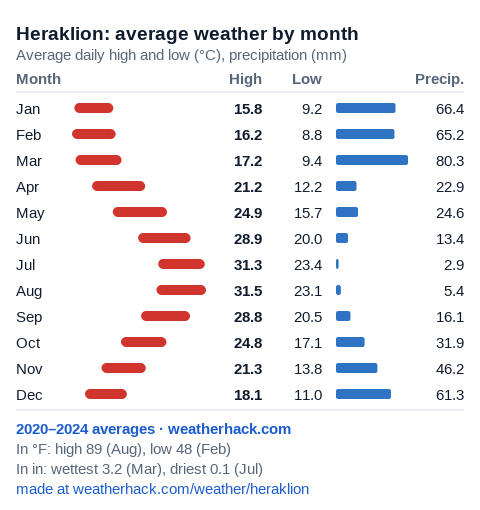
Plain HTML: a picture and a link. No script, no cookies, nothing to install.
Heraklion in January — frequently asked questions
Quick answers computed from the same climate normals as the figures above — except the sea-temperature answer, which comes from Open-Meteo's marine model for 2023 and 2024.
What is the weather like in Heraklion in January?
In January, Heraklion averages a 15.8 °C (60 °F) daytime high and a 9.2 °C (49 °F) overnight low, with about 66.4 mm (2.6 in) of precipitation over the month, roughly 7.5 hours of sunshine a day and relative humidity near 72%. These are 2020–2024 ERA5 monthly averages, not a forecast.
How much does it rain in Heraklion in January?
Heraklion gets about 66.4 mm (2.6 in) of precipitation in an average January, which is one of the wetter months of the year here (the year averages 36.4 mm (1.4 in) a month). Figures count both rain and melted snow.
How many days does it rain in Heraklion in January?
Rain or snow reaches at least 1 mm on about 12.0 days in an average January in Heraklion — roughly 39% of days. Counted from daily ERA5 records for 2020–2024; the 1 mm cut-off is the WMO rain-day threshold, so light drizzle is not counted.
What should I pack for Heraklion in January?
Cool 15.8 °C (60 °F) days call for a jumper or light jacket. Evenings cool to about 9.2 °C (49 °F), so a light layer after dark is useful. Expect a fair amount of rain — about 66.4 mm (2.6 in) over the month — so pack an umbrella or a waterproof. It falls on about 12.0 days of the month — days recording at least 1 mm, the WMO rain-day threshold — or about 1.9 days of any five you are there. Averaged over those days the rain is moderate: about 5.5 mm (0.2 in) each, a proper shower you will want cover for — though that per-day figure is a ceiling rather than a typical day, since the sub-1 mm days feed the monthly total too.
How warm is it in Heraklion at 8 pm in January?
At 8 pm: usually about 12 °C (54 °F) in January, against an average high of 15.8 °C (60 °F) and low of 9.2 °C (49 °F). For dinner outside, a real jacket rather than just a sweater, if you will sit outside for long. It is the mean of every 20:00 local time (Europe/Athens, following daylight saving) in January 2020–2024, from hourly ERA5 temperatures in the Open-Meteo historical weather archive for the grid cell covering Heraklion — not a forecast: single evenings run several degrees either side, and a sheltered terrace feels warmer than an open, breezy spot.
Is January a good time to visit Heraklion?
January is one of the less comfortable months in Heraklion on our comfort score, ranking 12th of 12, with a mean daily temperature around 12.5 °C (55 °F) — expect cold conditions. It uses the same comfort score as our best-weather rankings — it rewards a mild 18–24 °C mean daily temperature and lightly penalises rain, and it ignores humidity, wind, daylight and crowds, so treat it as a data-driven starting point rather than a verdict.
How windy is Heraklion in January?
The sustained 10-metre wind in Heraklion averages 6.2 m/s (22 km/h / 14 mph) in January, the same figure quoted higher up this page. That average is taken over the highest sustained reading of each day, so most hours of a typical January day sit below it rather than at it. Gusts are a separate number: a windy January day peaks near 12.6 m/s (45 km/h / 28 mph), which is a short peak inside the wind rather than a speed it holds for hours. Both figures are 2020–2024 ERA5 monthly averages for the reanalysis grid cell covering Heraklion, not a forecast: an exposed waterfront, ridge or open plaza runs windier than the cell average, a sheltered street runs calmer, and single days vary far more than a five-year mean can show.
How humid is Heraklion in January, and how muggy does it feel?
Relative humidity in Heraklion averages about 72% through January, for a mean dew point of 7.3 °C (45 °F) — the same figures quoted higher up this page. Mugginess follows the dew point rather than the percentage, because relative humidity is measured against the air temperature and the same percentage feels nothing alike on a cold morning and a hot afternoon. On the band this page states — a dew point above 20 °C feels oppressive, 16–20 °C feels humid and sticky, 10–15 °C is comfortable, and below 10 °C feels dry — January in Heraklion is dry: the air feels dry and the heat feels lighter than the thermometer suggests. Both are 2020–2024 ERA5 monthly means for the reanalysis grid cell covering Heraklion, averaged over every hour of the month rather than over muggy afternoons alone, so a humid spell runs above these figures and a dry one below them.
How strong is the sun in Heraklion in January?
Across January, the mean of the daily maximum UV index in Heraklion is 2.0, averaged over 2023 and 2024. That is an average of each day’s highest reading, which normally falls around solar noon, so a cloudless January day here runs above 2.0 and an overcast one below it — the figure is a mid-day peak averaged over days, not a level the sun holds from morning to evening. Strength is a separate question from how long the sun is up and from how many hours of it get through the cloud: this number says nothing about either. It is CAMS-derived ultraviolet from Open-Meteo for the grid point covering Heraklion — a two-year mean, and a different archive from the one behind the temperature and rainfall figures on this page.
How hot and how cold does it actually get in Heraklion in January?
Across the 2020–2024 daily observations, the hottest day in January in Heraklion reached 27.4 °C (81 °F) and the coldest night fell to 0.6 °C (33 °F) — a five-year observed range, not the extreme of a longer history. Those are two single days out of five years of January, so a typical January sits well inside them: the averages above are a 15.8 °C (60 °F) daytime high and a 9.2 °C (49 °F) overnight low. Both edges come from daily ERA5 values for the reanalysis grid cell covering Heraklion rather than from a station thermometer in the city, so a sheltered courtyard or an exposed hilltop within the same city can read warmer or colder than either figure.
How long are the days in Heraklion in January?
In the middle of January the day itself — sunrise to sunset — lasts 10 hours 4 minutes in Heraklion. Day length is set by latitude and the tilt of the Earth, so this is computed for Heraklion’s latitude at mid-month, not measured: it reads no weather data, and cloud, rain or heat cannot change it. It is a mid-month sample rather than an average of the whole month: near the solstices the length barely moves across four weeks, while near the equinoxes a mid-latitude city gains or loses two to three minutes a day, so the ends of January can sit roughly half an hour either side of this figure. It is also not the sunshine figure: the 7.5 hours a day quoted above are a modelled estimate of how much of that day the sun actually gets through, which is always the smaller number.
What time does it get dark in Heraklion in January?
In Heraklion the sun sets at 17:18 on 1 January 2027, 17:30 on 15 January and 17:46 on 31 January, and it rises at 07:28 on 1 January, 07:28 on 15 January and 07:20 on 31 January. These are local clock times, summer time included (UTC+2 on all three dates). They are computed with the NOAA solar equations for the sun's upper edge on a flat sea-level horizon, not observed: hills or tall buildings can hide the sun a few minutes before the sunset time, and it is not fully dark until twilight ends after it.
How many days is there snow on the ground in Heraklion in January?
On average 1.0 days of January in Heraklion had at least 1 cm of snow lying in 2020–2024 (5 days across the five Januarys), counted from the daily mean snow depth of the ERA5-Land model. It counts snow still lying from earlier falls, so it is a different figure from the days on which snow falls. This is a model estimate for open ground across a grid cell roughly 9 km wide, not a snow-stake reading: cleared streets, pavements and the warmer city centre usually lose snow sooner, and higher ground keeps it longer. A five-year mean also hides the spread: one January can be white for weeks and the next bare.
How much does January in Heraklion vary from year to year?
Across 2020–2024 the average daytime high for January in Heraklion ran from 13.8 °C (57 °F) in its coolest year to 17.5 °C (64 °F) in its warmest — five annual values of a monthly mean daily high, one per year, not five individual days. The gap between the coolest and the warmest of those five is 3.7 °C (7 °F), so the 15.8 °C (60 °F) average quoted above is a middle the individual years sit either side of rather than a figure any one January actually landed on. That gap is how much weight the average deserves: a month whose five years agreed to within a degree is a far safer thing to plan a trip around than one that swung four, and this January swung 3.7 °C. Each of the five is a whole January averaged, from daily ERA5 values for the reanalysis grid cell covering Heraklion — it is the month as a unit moving between years, not the day-to-day scatter inside any one of them.
Does Heraklion warm up or cool down across January?
January in Heraklion cools as it goes: daytime highs average 17.2 °C (63 °F) over the first ten days of the month and 14.9 °C (59 °F) from the 21st to the end of it, so the last week is the cooler end of January. Both figures are averages of the same 2020–2024 daily ERA5 values behind every other temperature on this page, taken over those two ten-day windows instead of over the whole month. That is why the single January average of 15.8 °C (60 °F) quoted above sits between them and matches neither end: for a trip of a week or two, which part of January you pick changes the warmth you get more than which year you go. These are air temperatures drifting across the month, not day length — daylight shifts across January as well, but that is a separate figure on this page with separate numbers.
How warm is the sea in Heraklion in January?
The sea off Heraklion averages 17.3 °C (63 °F) through January, measured at the nearest ocean grid point about 13.4 km from the city: a modelled sea-surface temperature averaged over the two years 2023 and 2024, from Open-Meteo's marine model rather than the land archive behind the temperature, rainfall and wind figures on this page. Treat it as the typical surface water for the month as a whole, not as the reading you would get wading in off a particular beach on the day you arrive. For scale inside Heraklion's own year: the sea is warmest in August at 27.8 °C (82 °F) and coolest in March at 16.6 °C (62 °F), which puts January about 10.5 °C below the warm end and 0.7 °C above the cool end.
Heraklion weather in other months
- January
- February — avg high 16.2 °C (61 °F), low 8.8 °C (48 °F)
- March — avg high 17.2 °C (63 °F), low 9.4 °C (49 °F)
- April — avg high 21.2 °C (70 °F), low 12.2 °C (54 °F)
- May — avg high 24.9 °C (77 °F), low 15.7 °C (60 °F)
- June — avg high 28.9 °C (84 °F), low 20.0 °C (68 °F)
- July — avg high 31.3 °C (88 °F), low 23.4 °C (74 °F)
- August — avg high 31.5 °C (89 °F), low 23.1 °C (74 °F)
- September — avg high 28.8 °C (84 °F), low 20.5 °C (69 °F)
- October — avg high 24.8 °C (77 °F), low 17.1 °C (63 °F)
- November — avg high 21.3 °C (70 °F), low 13.8 °C (57 °F)
- December — avg high 18.1 °C (65 °F), low 11.0 °C (52 °F)
← Full Heraklion forecast & climate · Best weather in January (all cities)