Cyprus (Limassol) weather forecast
Live conditions, hour-by-hour and 7-day outlook for Limassol, Limassol District, Cyprus. Every figure on this page is for Limassol, on the south coast of Cyprus; other parts of the island can differ — inland Nicosia has hotter summer days and colder winter nights, and the Troodos mountains are far colder and get winter snow — and they are not measured here.
What is the weather like in Limassol?
In short, Limassol has an annual average daytime high of about 24.8 °C (77 °F) and overnight lows near 16.6 °C (62 °F). Summers (Jun–Aug) feel hot, with daytime highs averaging about 31.8 °C (89 °F), while winters (Dec–Feb) turn mild, highs around 17.5 °C (64 °F) and nights near 10.2 °C (50 °F). January is normally the wettest month (about 107.1 mm) and July the driest (about 0.2 mm), and June is the sunniest, averaging roughly 13.9 hours of sunshine a day.
- Annual average high
- 24.8 °C / 77 °F
- Annual average low
- 16.6 °C / 62 °F
- Wettest month
- January (107.1 mm)
- Driest month
- July (0.2 mm)
- Sunniest month
- June (13.9 h/day)
A quick summary computed from Limassol's 2020–2024 ERA5 monthly normals and sunshine data: annual figures are the mean of the twelve monthly averages, wettest and driest months are ranked by mean precipitation, and summer/winter use the meteorological seasons for the northern hemisphere. One figure further down this page sits outside that. The sea-surface temperature by month is neither ERA5 nor five-year: it comes from Open-Meteo's marine model and averages 2023 and 2024 only, because the ERA5 archive holds no usable sea-surface temperature and the marine record is not complete before 2023.
Air quality in Limassol
Air quality in Limassol is measured with the European Air Quality Index (EAQI), a scale that starts at 0 and is grouped into plain-language bands: Good (0–20), Fair (20–40), Moderate (40–60), Poor (60–80), Very poor (80–100) and Extremely poor (above 100). The lower the number, the cleaner the air. From “Poor” upward, sensitive groups — young children, older adults and anyone with heart or lung conditions — may want to limit prolonged or heavy outdoor exertion.
PM2.5 and PM10 are fine and coarse particulate matter — airborne particles smaller than 2.5 and 10 micrometres, produced by traffic, wood and coal burning, industry and wind-blown dust. PM2.5 is the more harmful fraction because the tiny particles travel deep into the lungs and bloodstream; both are reported in micrograms per cubic metre (µg/m³). The live figures above for Limassol refresh hourly from the Copernicus Atmosphere Monitoring Service via Open-Meteo, and may be unavailable for some remote areas with sparse monitoring coverage.
Sunrise, sunset & daylight in Limassol
The sun rises and sets a few minutes earlier or later each day in Limassol, and the gap between them — the length of the day — stretches out through spring and draws in through autumn. The panel below shows today's sunrise and sunset for Limassol in the city's own local time, plus the total hours of daylight between them, so you can plan an early start, a run, a photo at golden hour or getting home before dark. All times are for Limassol's time zone, not your device's.
The UV index rates the strength of the sun's ultraviolet radiation on a scale the World Health Organization groups into bands: 0–2 Low, 3–5 Moderate, 6–7 High, 8–10 Very high and 11+ Extreme. The higher the number, the faster unprotected skin and eyes burn. From Moderate upward it is worth using sunscreen, a hat and sunglasses; at High and above, seek shade around the middle of the day and cover up, because sunburn can set in within minutes. The value shown above is today's maximum UV for Limassol, usually reached in the early afternoon. The sunrise, sunset, day-length and UV figures all refresh from Open-Meteo (CC-BY 4.0), which may report no UV value for far-northern or far-southern locations during the darkest weeks of winter.
Average weather by month in Limassol
On average, the warmest month in Limassol is July, with daily highs around 33.2 °C (92 °F), while the coldest is January, when highs average 16.7 °C (62 °F) and nights dip to about 9.9 °C (50 °F). January is typically the wettest month, with around 107.1 mm of precipitation in total. The table below shows the typical daily high, daily low, total monthly precipitation and number of rain days for each month of the year in Limassol.
| Month | Avg high | Avg low | Precipitation | Rain days |
|---|---|---|---|---|
| January | 16.7 °C / 62 °F | 9.9 °C / 50 °F | 107.1 mm | 11.4 |
| February | 16.9 °C / 62 °F | 9.0 °C / 48 °F | 43.0 mm | 6.8 |
| March | 18.4 °C / 65 °F | 10.4 °C / 51 °F | 25.2 mm | 6.2 |
| April | 22.9 °C / 73 °F | 14.0 °C / 57 °F | 20.1 mm | 4.0 |
| May | 26.5 °C / 80 °F | 17.8 °C / 64 °F | 6.1 mm | 2.2 |
| June | 29.5 °C / 85 °F | 21.1 °C / 70 °F | 0.8 mm | 0.2 |
| July | 33.2 °C / 92 °F | 24.2 °C / 76 °F | 0.2 mm | 0.0 |
| August | 32.7 °C / 91 °F | 24.3 °C / 76 °F | 0.8 mm | 0.2 |
| September | 30.9 °C / 88 °F | 22.3 °C / 72 °F | 1.0 mm | 0.2 |
| October | 27.8 °C / 82 °F | 18.9 °C / 66 °F | 17.2 mm | 1.4 |
| November | 23.0 °C / 73 °F | 15.0 °C / 59 °F | 36.2 mm | 6.6 |
| December | 19.0 °C / 66 °F | 11.7 °C / 53 °F | 78.5 mm | 8.8 |
Climate normals computed from ERA5 reanalysis daily data for 2020–2024 via the Open-Meteo historical weather archive (CC-BY 4.0). Table cells are averages over those five years; precipitation is the mean monthly total. The rain-day column counts days recording at least 1 mm of precipitation — the WMO rain-day threshold, so light drizzle is deliberately not counted — averaged over the same five years; snow counts towards that threshold as its melted water equivalent — the millimetres of water it makes, not its depth as snow.
Take the data: Download Limassol climate data (CSV) · JSON — all 19 columns behind this page, twelve monthly rows deep: everything in the table above plus wind speed and gusts, humidity and dew point, sunshine hours and cloud cover, the hottest day and coldest night observed in each month over 2020–2024, the mean high across a month’s first ten days and its last ten, the monthly snow total in cm with the number of days reaching 1 cm and the average sea-surface temperature. Where no snow falls, snow_cm and snow_days read 0 in all twelve months — a real answer, not a gap. Browse the other 152 cities' downloadable data.
Going to Limassol?
Places to stay in Limassol · Things to do in Limassol
Ordinary links with no affiliate codes. We count the clicks to learn whether readers want them; we earn nothing from them today.
Average temperature & rainfall by month in Limassol
In an average year Limassol's warmest month is July (daily highs near 33.2 °C) while January is usually the wettest, with about 107.1 mm (4.2 in) of rain — the climograph below shows the full year at a glance.
Built from the same 2020–2024 ERA5 monthly normals as the table above: bars are the mean monthly precipitation total (right axis, mm) and the two lines are the average daily high and low temperature (left axis, °C). Axis ranges are scaled to Limassol's own yearly minimum and maximum, so charts for different cities are not directly comparable by height.
Embed this chart on your site
A picture of Limassol's twelve monthly averages (high, low and precipitation, 2020–2024) for a blog post, a lesson or a forum reply. It links back to this page and names it in its footer.
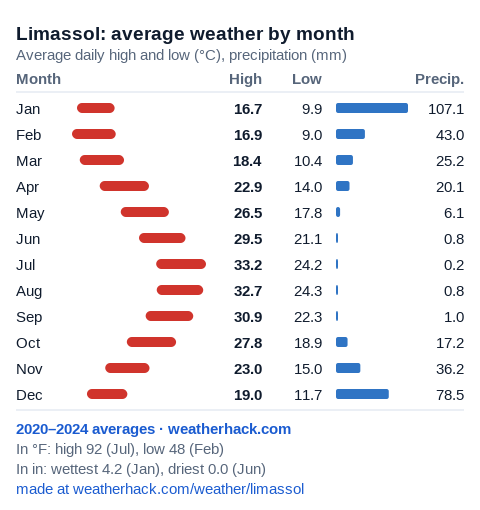
Plain HTML: a picture and a link. No script, no cookies, nothing to install.
Explore Limassol's climate month by month
Pick a month to see Limassol's typical daytime high, overnight low, rainfall and sunshine — with a quick what-to-pack line for that month. It turns the monthly table and climograph above into a single control; every figure is computed in your browser from the same 2020–2024 climate normals already shown on this page, so there is no live forecast and no sign-up.
Best time to visit Limassol
Based on typical temperatures, rain, sunshine and mugginess, the best time to visit Limassol is October, May and June. October sees daytime highs averaging 27.8 °C (82 °F) and about 10.7 hours of sunshine a day, with rain on about 1.4 of its 31 days and 17.2 mm in all. April, November and July make reasonable shoulder-season alternatives, while January, February and December rank lowest on this measure — January is the wettest stretch, with rain on about 11.4 of its 31 days and about 107.1 mm in all. This ranking weighs mean daily temperature, rain days, monthly rainfall, sunshine hours and dew point, with a floor under any month whose average daily high tops 30 °C, using 2020–2024 ERA5 normals; it does not account for relative humidity, wind, crowds or prices, so treat it as a starting point rather than a verdict.
- Recommended: October — 27.8 °C / 82 °F, 17.2 mm; May — 26.5 °C / 80 °F, 6.1 mm; June — 29.5 °C / 85 °F, 0.8 mm
- Shoulder season: April — 22.9 °C / 73 °F, 20.1 mm; November — 23.0 °C / 73 °F, 36.2 mm; July — 33.2 °C / 92 °F, 0.2 mm
- Best avoided: January — 16.7 °C / 62 °F, 107.1 mm; February — 16.9 °C / 62 °F, 43.0 mm; December — 19.0 °C / 66 °F, 78.5 mm
The months ranked above are five-year averages, and the five years behind them agreed far better in some months than in others. In Limassol, the widest year-to-year disagreement is in March, whose average daily high spanned 6.2 °C (11 °F) between the warmest and coolest of the five years, while the steadiest month is May, at 1.8 °C (3 °F). The wider that figure, the less the average above tells you about the month you will actually get: plan around the steady end and the number on this page is close to what turns up, plan around the wide end and it is a midpoint the individual years sat well either side of. These are five annual values of a monthly mean daily high, one per year, not five individual days — the same calendar month measured against itself in five different years, not the summer-to-winter gap and not any single hot or cold day.
Comfort ranking from the same normals as the tables above, every term priced in degrees of discomfort: 1 point per °C the mean daily temperature falls outside a mild 18–24 °C band (at least 6 when the average daily high tops 30 °C), 0.35 per rain day (a day with at least 1 mm), 0.01 per mm of monthly rainfall, 0.4 per hour of daily sunshine short of 9 and 0.3 per °C of dew point above a muggy 18 °C — so 20 rain days cost the same as 7 °C of cold or heat, a 100 mm month adds 1 point and a four-hours-of-sun day 2; lowest score wins, a month whose highs top 30 °C leads only if it is also the driest, and the wettest month is never placed in the top six.
What to wear & when to visit Limassol
Packing for Limassol comes down to the two extremes in its own climate record. Its summers are hot: the warmest month, July, averages daytime highs of 33.2 °C (92 °F), above the ~28 °C mark, so pack lightweight, breathable fabrics such as linen and cotton, plus sun protection and a refillable water bottle. Its winters are cool: even the coldest month, February, only falls to about 9.0 °C (48 °F), in the ~7–14 °C band, so a light jacket or sweater covers the coldest nights. Pack rain protection: the wettest month, January, averages about 107.1 mm (4.2 in) of precipitation — above the ~100 mm level where a packable waterproof or umbrella earns its place.
On the same logic as the "best time to visit" section above (months whose mean daily temperature sits closest to an 18–24 °C comfort band, with penalties for rain days, rainfall, missing sunshine, a muggy dew point and highs above 30 °C), the most comfortable months to visit Limassol are October, May and June. In the northern hemisphere, those mild months sit in Limassol's spring-to-autumn window rather than mid-winter.
Clothing guidance is keyed to Limassol's warmest-month average high and coldest-month average low from the same 2020–2024 ERA5 monthly normals used above, tested against the temperature thresholds stated in the text; the rain note flags any month above ~100 mm of precipitation. These are averages of typical months, not record heat, cold or storms, so pack a margin for unusual days.
Limassol weather by month
Planning a trip? Each month below has its own page for Limassol — typical high, low and rainfall, what to pack and whether it is a good time to visit, all from 2020–2024 climate normals.
- January — avg high 16.7 °C (62 °F), low 9.9 °C (50 °F)
- February — avg high 16.9 °C (62 °F), low 9.0 °C (48 °F)
- March — avg high 18.4 °C (65 °F), low 10.4 °C (51 °F)
- April — avg high 22.9 °C (73 °F), low 14.0 °C (57 °F)
- May — avg high 26.5 °C (80 °F), low 17.8 °C (64 °F)
- June — avg high 29.5 °C (85 °F), low 21.1 °C (70 °F)
- July — avg high 33.2 °C (92 °F), low 24.2 °C (76 °F)
- August — avg high 32.7 °C (91 °F), low 24.3 °C (76 °F)
- September — avg high 30.9 °C (88 °F), low 22.3 °C (72 °F)
- October — avg high 27.8 °C (82 °F), low 18.9 °C (66 °F)
- November — avg high 23.0 °C (73 °F), low 15.0 °C (59 °F)
- December — avg high 19.0 °C (66 °F), low 11.7 °C (53 °F)
When is the rainy season in Limassol?
Limassol receives about 336 mm of precipitation in an average year. The wettest stretch is December–February, which alone brings roughly 229 mm (9.0 in) — about 68% of the annual total — while the driest three months (June–August) add only around 2 mm (0.1 in) (1%). Because the wettest quarter holds 68% of the yearly rain, it has a pronounced wet/dry pattern — most of the year's rain is packed into just a few months of marked seasonality.
The wettest single month is January at about 107 mm, and the driest is July at roughly 0 mm — a gap of 107 mm between the two.
How often it rains, not just how much: the wettest stretch (December–February) records about 27 days with at least 1 mm of precipitation between them, against roughly 0 days across the driest three months (June–August). January sees rain on about 11.4 days and July on about 0.0. January is the wettest month both by total and by number of rain days, so its rain is frequent as well as heavy. Across a full year Limassol counts roughly 48 rain days — days recording at least 1 mm, the WMO rain-day threshold, so light drizzle is deliberately not counted, and a day of snow counts towards that tally as its melted water equivalent, the millimetres of water it makes.
| Extreme | Month | Avg precipitation |
|---|---|---|
| Wettest month | January | 107 mm |
| Driest month | July | 0 mm |
Precipitation figures are the same 2020–2024 ERA5 monthly normals used above, summed from the Open-Meteo historical archive (CC-BY 4.0). The rainy-season window is the wettest run of three consecutive months (wrapping December into January), and its share is that window's rainfall divided by the annual total. These are five-year averages of typical months, not records, and precipitation here counts both rain and melted snow.
Weather by season in Limassol
The warmest season in Limassol is summer (Jun–Aug), with daily highs averaging 31.8 °C (89 °F), while winter (Dec–Feb) is the wettest, bringing about 228.6 mm of precipitation across its three months. These figures group Limassol's twelve monthly normals into the four meteorological seasons; because Limassol lies in the northern hemisphere, December–February is winter and June–August is summer.
| Season | Avg high | Avg low | Total precipitation |
|---|---|---|---|
| Winter (Dec–Feb) | 17.5 °C / 64 °F | 10.2 °C / 50 °F | 228.6 mm |
| Spring (Mar–May) | 22.6 °C / 73 °F | 14.1 °C / 57 °F | 51.4 mm |
| Summer (Jun–Aug) | 31.8 °C / 89 °F | 23.2 °C / 74 °F | 1.8 mm |
| Autumn (Sep–Nov) | 27.2 °C / 81 °F | 18.7 °C / 66 °F | 54.4 mm |
Each season groups three months of the same 2020–2024 ERA5 normals used above: avg high and low are the mean of the three monthly averages, and total precipitation is the sum of the three monthly totals.
Annual temperature range & continentality in Limassol
In Limassol the warmest month is July, averaging about 28.7 °C (84 °F) across the day, while the coldest is February at around 13.0 °C (55 °F). That gives an annual mean-temperature range of 15.8 °C between the warmest and coldest months — enough to class Limassol's climate as transitional / moderately continental, meaning summers and winters differ clearly, but neither is extreme.
| Metric | Value |
|---|---|
| Warmest month (avg mean temp) | July — 28.7 °C / 84 °F |
| Coldest month (avg mean temp) | February — 13.0 °C / 55 °F |
| Annual mean-temperature range | 15.8 °C |
Computed from the same 2020–2024 ERA5 monthly normals used above: the warmest month is the one with the highest average daily high and the coldest the one with the lowest average daily low, and the range is the difference between those two months' mean daily temperatures (each the average of its daily high and low). Continentality thresholds used here: under 10 °C maritime/oceanic, 10–20 °C transitional, above 20 °C continental. This is a summary of typical months, not of record extremes.
Records & extremes in Limassol
Across the year, Limassol's hottest month on average is July, when daytime highs peak around 33.2 °C (92 °F), and its coldest is February, when overnight lows bottom out near 9.0 °C (48 °F). The wettest month is typically January, averaging about 107.1 mm of precipitation, while the driest is July at roughly 0.2 mm. The sharpest month-to-month change comes between October and November, when the average daily temperature drops by about 4.4 °C from one month to the next. Averages hide the edges: across the 2020–2024 daily records Limassol's hottest day reached 40.8 °C (105 °F) and its coldest night fell to 2.6 °C (37 °F) — a five-year observed range, not the extreme of a longer history.
| Extreme | Month | Figure |
|---|---|---|
| Hottest month (avg daily high) | July | 33.2 °C / 92 °F |
| Coldest month (avg daily low) | February | 9.0 °C / 48 °F |
| Wettest month (mean precipitation) | January | 107.1 mm |
| Driest month (mean precipitation) | July | 0.2 mm |
| Largest month-to-month swing | October → November | −4.4 °C mean temp |
These are extremes of Limassol's twelve 2020–2024 ERA5 monthly normals — the highest and lowest of the monthly averages, and the biggest change between two neighbouring months' mean daily temperature (each the average of its daily high and low). They are climate-normal extremes over that five-year averaging window, not all-time station records: a single day can run far hotter, colder or wetter than any monthly figure in the table, which is why the paragraph above also gives the hottest day and coldest night actually measured in the same 2020–2024 window — 40.8 °C against a hottest monthly average of 33.2 °C, and 2.6 °C against a coldest monthly average of 9.0 °C. That observed pair is itself only five years of daily values at one ERA5 grid point, so a longer history would very likely stretch both ends further.
Seasonal weather patterns in Limassol
The warmest month in Limassol is July, with average highs near 33.2 °C (92 °F), and the coolest is January, when overnight lows average about 9.9 °C (50 °F) — so summer here centres on July and winter on January. That works out to a spread of roughly 23.3 °C between the hottest month's daytime high and the coldest month's overnight low, a moderate annual swing — a transitional temperate pattern whose seasons are clearly separated but stop short of extremes. Rain is highly seasonal: January is by far the wettest month at about 107.1 mm, while July is virtually dry at only 0.2 mm. Winds are typically strongest in March, at around 21 km/h (13 mph · 5.9 m/s), and lightest in December, at about 15 km/h (10 mph · 4.3 m/s).
Derived from the same 2020–2024 ERA5 monthly normals used above (wind from the matching ERA5 wind normals): warmest and coolest months are ranked by average daily high, wettest and driest by mean monthly precipitation, and the swing is the warmest month's average high minus the coolest month's average low. The maritime-vs-continental read is a summary of that swing, not of record extremes.
Limassol's climate type (Köppen–Geiger)
Limassol sits near a Köppen–Geiger boundary. The 1991–2020 reference map (Beck et al. 2023) classes it Csa, hot-summer Mediterranean; this page's own 2020–2024 figures read BSh, hot semi-arid (steppe). A coldest month averaging 13.0 °C, a warmest month near 28.7 °C and about 336 mm of precipitation across the year place it in the hot semi-arid (steppe) band. The two part at the dryness test: here the yearly total of 336 mm falls short of the dry line of 413 mm, 20 × the 20.7 °C annual mean with no offset, as under 30% of the rain falls in the warm half-year, which makes it arid on this page, while the reference map puts it on the wet side of that line.
Derived from the same 2020–2024 ERA5 monthly normals used above: each month's mean temperature is the average of its daily high and low, the aridity test uses the standard 20·(annual mean temperature) rule with the warm-season precipitation offset, and the temperate/continental split uses the 0 °C coldest-month boundary. The reference class is read at the city's coordinates from the 1 km 1991–2020 map of Beck, McVicar, Vergopolan et al. (2023), Scientific Data 10, 724 (doi:10.1038/s41597-023-02549-6), published under CC BY 4.0.
Heating & cooling degree days in Limassol
Using a base temperature of 18 °C, Limassol accumulates about 481 heating degree days (HDD) and 1,472 cooling degree days (CDD) in an average year. That makes Limassol a cooling-dominated climate — most of the year's energy demand goes into cooling buildings rather than heating them.
Degree days measure how far, and for how long, the outside temperature sits away from a comfortable baseline — here 18 °C, the point below which buildings typically need heating and above which they need cooling. A month whose average temperature is 8 °C below the base across 30 days adds 240 heating degree days; the further from 18 °C and the longer it lasts, the higher the total, which is why they track roughly with heating and air-conditioning energy use.
| Month | Mean temp | HDD | CDD |
|---|---|---|---|
| January | 13.3 °C / 56 °F | 146 | 0 |
| February | 13.0 °C / 55 °F | 141 | 0 |
| March | 14.4 °C / 58 °F | 112 | 0 |
| April | 18.5 °C / 65 °F | 0 | 13 |
| May | 22.2 °C / 72 °F | 0 | 129 |
| June | 25.3 °C / 78 °F | 0 | 219 |
| July | 28.7 °C / 84 °F | 0 | 332 |
| August | 28.5 °C / 83 °F | 0 | 326 |
| September | 26.6 °C / 80 °F | 0 | 258 |
| October | 23.4 °C / 74 °F | 0 | 166 |
| November | 19.0 °C / 66 °F | 0 | 30 |
| December | 15.4 °C / 60 °F | 82 | 0 |
Computed from the same 2020–2024 ERA5 monthly normals used above: each month's mean temperature is the average of its daily high and low, HDD = max(0, 18 − mean) × days in month and CDD = max(0, mean − 18) × days in month, summed over the year. These are long-term climatological estimates, not a substitute for a metered energy audit.
Growing season & growing degree days in Limassol (for gardeners)
In an average year Limassol offers a year-round frost-free window and accumulates roughly 3,911 growing degree days (base 10 °C), with the strongest growth in July.
For gardeners, two things drive what you can grow outdoors and when: how long the season stays frost-free, and how much warmth accumulates over that season. In Limassol, no month in Limassol averages an overnight low below 0 °C, so on these normals the frost-free growing window is effectively year-round (all 12 months). Warm-season crops such as tomatoes, beans, peppers and maize only add growth once the daily mean climbs above about 10 °C, so the growing degree days (GDD) below — one point for each degree-day the mean temperature spends above that base — track how much usable heat the season delivers.
| Month | Avg mean temp | GDD (base 10 °C) |
|---|---|---|
| January | 13.3 °C / 56 °F | 102 |
| February | 13.0 °C / 55 °F | 83 |
| March | 14.4 °C / 58 °F | 136 |
| April | 18.5 °C / 65 °F | 253 |
| May | 22.2 °C / 72 °F | 377 |
| June | 25.3 °C / 78 °F | 459 |
| July | 28.7 °C / 84 °F | 580 |
| August | 28.5 °C / 83 °F | 574 |
| September | 26.6 °C / 80 °F | 498 |
| October | 23.4 °C / 74 °F | 414 |
| November | 19.0 °C / 66 °F | 270 |
| December | 15.4 °C / 60 °F | 166 |
The frost-free window is the longest run of consecutive months whose average overnight low stays above 0 °C, from the same 2020–2024 ERA5 monthly normals used above; growing degree days use GDD = max(0, mean − 10 °C) × days in month, where mean = (high + low) ÷ 2, summed to an annual total of about 3,911. Because these are monthly-mean approximations, not day-level records, they will not capture a late-spring or early-autumn frost on an individual clear night, and they are no substitute for your area's published last-frost and first-frost dates — check those before setting out tender seedlings.
Day-to-night temperature swing in Limassol
In Limassol, days are on average 8.2 °C warmer than nights. The day-to-night swing is largest in July (about 9.0 °C between the average high and low) and smallest in January (about 6.8 °C).
The diurnal range is simply the daytime high minus the overnight low for a given month — a rough measure of how much the temperature drops after dark. A large swing (common in dry, continental or high-altitude places) means warm afternoons and chilly nights, so an extra layer for the evening pays off; a small swing (typical of humid coastal and maritime climates, where the sea holds the temperature steady) means the night feels much like the day.
| Month | Avg high | Avg low | Swing |
|---|---|---|---|
| January | 16.7 °C / 62 °F | 9.9 °C / 50 °F | 6.8 °C |
| February | 16.9 °C / 62 °F | 9.0 °C / 48 °F | 7.9 °C |
| March | 18.4 °C / 65 °F | 10.4 °C / 51 °F | 8.0 °C |
| April | 22.9 °C / 73 °F | 14.0 °C / 57 °F | 8.9 °C |
| May | 26.5 °C / 80 °F | 17.8 °C / 64 °F | 8.7 °C |
| June | 29.5 °C / 85 °F | 21.1 °C / 70 °F | 8.4 °C |
| July | 33.2 °C / 92 °F | 24.2 °C / 76 °F | 9.0 °C |
| August | 32.7 °C / 91 °F | 24.3 °C / 76 °F | 8.4 °C |
| September | 30.9 °C / 88 °F | 22.3 °C / 72 °F | 8.6 °C |
| October | 27.8 °C / 82 °F | 18.9 °C / 66 °F | 8.9 °C |
| November | 23.0 °C / 73 °F | 15.0 °C / 59 °F | 8.0 °C |
| December | 19.0 °C / 66 °F | 11.7 °C / 53 °F | 7.3 °C |
Computed from the same 2020–2024 ERA5 monthly normals used above: each month's swing is its average daily high minus its average daily low, and the annual figure is the mean of the 12 monthly swings. These are averages of typical days, not the largest single-day swings on record, which can be considerably wider.
How windy is Limassol? Average wind speed by month
On average, the windiest month in Limassol is March, when the daily-maximum wind speed averages about 21 km/h (13 mph · 5.9 m/s), while the calmest is December at around 15 km/h (10 mph · 4.3 m/s). Across the whole year the daily peak wind averages roughly 19 km/h (12 mph · 5.2 m/s) in Limassol.
The table below shows the typical daily-maximum wind speed and daily-maximum gust for each month in Limassol. Wind speed is the sustained 10-metre wind; a gust is the short peak within it, which is why gust figures run higher. Each value is given in km/h, mph and metres per second (m/s), the unit the underlying ERA5 data is stored in; all three are the same measurement, with km/h and mph rounded to whole units.
| Month | Avg wind speed | Avg gust |
|---|---|---|
| January | 19 km/h (12 mph · 5.4 m/s) | 39 km/h (24 mph · 10.9 m/s) |
| February | 18 km/h (11 mph · 5.1 m/s) | 37 km/h (23 mph · 10.4 m/s) |
| March | 21 km/h (13 mph · 5.9 m/s) | 44 km/h (27 mph · 12.2 m/s) |
| April | 19 km/h (12 mph · 5.3 m/s) | 41 km/h (26 mph · 11.4 m/s) |
| May | 21 km/h (13 mph · 5.7 m/s) | 44 km/h (27 mph · 12.1 m/s) |
| June | 20 km/h (13 mph · 5.6 m/s) | 44 km/h (27 mph · 12.1 m/s) |
| July | 19 km/h (12 mph · 5.4 m/s) | 41 km/h (26 mph · 11.5 m/s) |
| August | 20 km/h (13 mph · 5.6 m/s) | 43 km/h (27 mph · 11.9 m/s) |
| September | 19 km/h (12 mph · 5.2 m/s) | 40 km/h (25 mph · 11.1 m/s) |
| October | 16 km/h (10 mph · 4.4 m/s) | 34 km/h (21 mph · 9.5 m/s) |
| November | 17 km/h (10 mph · 4.6 m/s) | 35 km/h (21 mph · 9.6 m/s) |
| December | 15 km/h (10 mph · 4.3 m/s) | 32 km/h (20 mph · 8.8 m/s) |
Computed from the same 2020–2024 ERA5 reanalysis daily data used above, via the Open-Meteo historical weather archive (CC-BY 4.0). Each cell is the average, over those five years, of that month's daily-maximum 10 m wind speed (or gust); the km/h and mph figures are that same m/s figure converted, each rounded to the nearest whole unit, so a 0.1 m/s difference between two months can leave their rounded km/h or mph readings equal. These are climatological averages of typical daily peaks, not record extremes.
Humidity in Limassol: how muggy it feels by month
Averaged across the year, relative humidity in Limassol runs about 60%. The most humid month is December (around 69%), and the least humid is July (about 53%).
How humid it actually feels tracks the dew point more than the percentage. The muggiest-feeling month in Limassol is August, when the dew point averages about 19.0 °C (66 °F) — humid and sticky: it feels noticeably muggy, especially in the sun or overnight.
The table below shows the average relative humidity and the average dew point for each month in Limassol. Relative humidity is the percentage of moisture the air is holding relative to its maximum at that temperature; the dew point is the temperature to which air must cool to become saturated, and it is the better guide to how sticky it actually feels. As a rule of thumb, a dew point above 20 °C feels oppressive, 16–20 °C feels humid and sticky, 10–15 °C is comfortable, and below 10 °C feels dry.
| Month | Avg relative humidity | Avg dew point |
|---|---|---|
| January | 68% | 7.0 °C / 45 °F |
| February | 66% | 6.3 °C / 43 °F |
| March | 61% | 6.5 °C / 44 °F |
| April | 57% | 9.0 °C / 48 °F |
| May | 56% | 12.1 °C / 54 °F |
| June | 60% | 16.2 °C / 61 °F |
| July | 53% | 17.5 °C / 64 °F |
| August | 59% | 19.0 °C / 66 °F |
| September | 56% | 16.7 °C / 62 °F |
| October | 54% | 12.7 °C / 55 °F |
| November | 61% | 10.5 °C / 51 °F |
| December | 69% | 9.3 °C / 49 °F |
Computed from hourly 2020–2024 ERA5 reanalysis data via the Open-Meteo historical weather archive (CC-BY 4.0). Each cell is the mean, over those five years, of every hour's relative humidity or dew point in that calendar month. These are monthly averages of typical conditions, not humid-day extremes — individual days can be considerably muggier or drier.
Sunshine and cloud cover in Limassol by month
The sunniest month in Limassol is June, averaging about 13.9 hours of sunshine a day, while the dullest is December at roughly 8.2 hours. Skies are cloudiest in January (about 47% cloud cover) and clearest in July (around 2%). Adding up the months, Limassol sees on the order of 4,028 hours of sunshine a year.
The table below shows the average daily sunshine (modelled sunshine hours per day) and the average cloud cover for each month in Limassol. Sunshine hours estimate how much of the day was sunny rather than cloudy, so they fall well short of daylight length on overcast days; cloud cover is the share of the sky hidden by cloud, averaged around the clock. The two move in opposite directions — more cloud means fewer sunshine hours.
| Month | Avg daily sunshine (h) | Avg cloud cover (%) |
|---|---|---|
| January | 8.4 | 47% |
| February | 9.0 | 39% |
| March | 10.5 | 38% |
| April | 11.5 | 31% |
| May | 12.8 | 19% |
| June | 13.9 | 7% |
| July | 13.9 | 2% |
| August | 12.7 | 3% |
| September | 11.7 | 5% |
| October | 10.7 | 18% |
| November | 9.0 | 35% |
| December | 8.2 | 44% |
Computed from 2020–2024 ERA5 reanalysis data via the Open-Meteo historical weather archive (CC-BY 4.0). Daily sunshine is the mean, over those five years, of each day's total sunshine duration in that calendar month (converted from seconds to hours); cloud cover is the mean of every hour's cloud fraction. The annual total is the sum of each month's mean daily sunshine multiplied by its number of days. These are averages of typical conditions, not record-sunny or record-dull extremes. The sunshine column is derived rather than tallied: it is ERA5's modelled sunshine_duration, worked out from the direct radiation reaching the reanalysis grid cell rather than read off a sunshine recorder, which is why our methodology asks you to read sunshine as indicative rather than exact. Radiation-derived sunshine runs higher than the station sunshine totals published elsewhere, so the honest use of these hours is comparing cities on this site against each other — Limassol comes off the same grid, the same five years and the same calculation as the 152 cities in our rankings, which puts it on a like-for-like scale with every one of them.
How warm is the sea in Limassol? Sea temperature by month
The sea off Limassol averages 28.6 °C (83 °F) through August, its warmest month, and 17.3 °C (63 °F) through February, its coolest, measured at the nearest ocean grid point about 6.0 km from the city: a modelled sea-surface temperature averaged over the two years 2023 and 2024, from Open-Meteo's marine model rather than the land archive behind every figure above. Treat it as the typical surface water for the month as a whole, not as the reading you would get wading in off a particular beach on the day you arrive.
Water carries heat away from the body about 25 times faster than air at the same temperature, which is why a 19 °C sea feels nothing like a 19 °C afternoon. As a rough guide for swimming without a wetsuit: 25 °C and above is bath-warm, 22–25 °C is comfortable for a long swim, 20–22 °C is swimmable but sharp on entry, 18–20 °C means short dips, 15–18 °C is cold enough that most unacclimatised swimmers want a wetsuit for anything longer than a plunge, and below about 15 °C cold-water shock — the involuntary gasp and rapid breathing on immersion — becomes a real hazard. Those upper boundaries are our own convention, not an official scale; the 15 °C mark is the one water-safety bodies use. On that scale the sea off Limassol is at 20 °C or more in 7 months of the year (May, June, July, August, September, October and November), and never falls below 15 °C.
| Month | Avg sea temperature | For swimming |
|---|---|---|
| January | 18.4 °C / 65 °F | brisk |
| February | 17.3 °C / 63 °F | cold |
| March | 17.9 °C / 64 °F | cold |
| April | 19.4 °C / 67 °F | brisk |
| May | 21.4 °C / 71 °F | swimmable |
| June | 25.3 °C / 78 °F | bath-warm |
| July | 28.0 °C / 82 °F | bath-warm |
| August | 28.6 °C / 83 °F | bath-warm |
| September | 27.4 °C / 81 °F | bath-warm |
| October | 25.7 °C / 78 °F | bath-warm |
| November | 23.0 °C / 73 °F | comfortable |
| December | 19.8 °C / 68 °F | brisk |
The water here runs behind the air. Limassol's warmest month on land is July, but the sea does not peak until August — 1 month later. A body of water takes far longer to warm and to cool than the land beside it, which is why a hot week in early summer need not mean warm water, and why the first cool weeks of autumn often still hold the summer's heat in the sea. Both figures here are pinned to whole calendar months, which blunts that effect — so read the table rather than assuming the water tracks the air.
Where this number comes from, and what it is not. Sea-surface temperature from Open-Meteo’s marine model (CC-BY 4.0): the daily sea_surface_temperature_mean for the nearest ocean grid cell, averaged over the two calendar years 2023 and 2024. That is a different source and a shorter window than every other table on this page, which uses 2020–2024 ERA5 land normals — and it cannot be made to match them. The ERA5 land archive carries no usable sea-surface temperature at all, and the marine model’s record does not run complete before 2023, so a longer window would either be empty or would under-weight most of the year. Two years is what honestly exists. Because the reading is an open-water grid cell about 6.0 km from Limassol, it will not capture a shallow sheltered bay that warms several degrees faster, a river mouth, or a cold upwelling that hugs one stretch of coast — and it is a monthly mean, so individual days sit either side of it. We publish it for Limassol because the marine model returned a near-complete two-year record from a cell close enough to count as the city’s own water — the same test that leaves 86 of the 152 cities in our rankings with no sea temperature at all rather than a guess. Inland cities have none, and neither do our two Great Lakes cities — the ocean model does not cover the lakes.
How hot or cold Limassol really feels — apparent temperature by month
The felt temperature diverges most from the thermometer in August: high humidity makes Limassol feel about 5.6 °C (10.1 °F) hotter than the thermometer's 32.7 °C (91 °F) daytime high — an apparent high near 38.3 °C (101 °F). The table below gives the heat-index or wind-chill "feels like" figure for every month.
The apparent temperature (or “feels like”) folds relative humidity (NWS Heat Index) for warm months and wind speed (NWS Wind Chill) for cold months into the plain air temperature, because the same reading feels hotter when the air is humid — sweat can't evaporate — and colder when the wind is up, stripping warmth from your skin. Bold “feels-like” cells below are months where humidity or wind moved the figure; the rest match the thermometer.
| Month | Avg high | Feels-like high | Avg low | Feels-like low |
|---|---|---|---|---|
| January | 16.7 °C / 62 °F | 16.7 °C / 62 °F | 9.9 °C / 50 °F | 7.3 °C / 45 °F |
| February | 16.9 °C / 62 °F | 16.9 °C / 62 °F | 9.0 °C / 48 °F | 6.3 °C / 43 °F |
| March | 18.4 °C / 65 °F | 18.4 °C / 65 °F | 10.4 °C / 51 °F | 10.4 °C / 51 °F |
| April | 22.9 °C / 73 °F | 22.9 °C / 73 °F | 14.0 °C / 57 °F | 14.0 °C / 57 °F |
| May | 26.5 °C / 80 °F | 26.5 °C / 80 °F | 17.8 °C / 64 °F | 17.8 °C / 64 °F |
| June | 29.5 °C / 85 °F | 31.8 °C / 89 °F | 21.1 °C / 70 °F | 21.1 °C / 70 °F |
| July | 33.2 °C / 92 °F | 37.7 °C / 100 °F | 24.2 °C / 76 °F | 24.2 °C / 76 °F |
| August | 32.7 °C / 91 °F | 38.3 °C / 101 °F | 24.3 °C / 76 °F | 24.3 °C / 76 °F |
| September | 30.9 °C / 88 °F | 33.8 °C / 93 °F | 22.3 °C / 72 °F | 22.3 °C / 72 °F |
| October | 27.8 °C / 82 °F | 28.5 °C / 83 °F | 18.9 °C / 66 °F | 18.9 °C / 66 °F |
| November | 23.0 °C / 73 °F | 23.0 °C / 73 °F | 15.0 °C / 59 °F | 15.0 °C / 59 °F |
| December | 19.0 °C / 66 °F | 19.0 °C / 66 °F | 11.7 °C / 53 °F | 11.7 °C / 53 °F |
Apparent temperatures combine the same 2020–2024 ERA5 monthly normals used above: the feels-like high applies the US National Weather Service Heat Index to a month's average daily high and mean relative humidity when that high averages 27 °C or more; the feels-like low applies the NWS Wind Chill to the average daily low and mean daily-maximum wind speed when that low averages 10 °C or less; otherwise the felt temperature equals the measured one. Because these mix monthly-average temperature with monthly-average humidity and wind, individual hot-and-humid afternoons or cold-and-windy nights can feel more extreme than the table shows.
How cold does Limassol get? Cold months & frost risk
The coldest month in Limassol is February, when overnight lows average about 9.0 °C (48 °F); no month averages below freezing, so widespread hard frost is uncommon, though clear, calm nights can still dip below zero. By contrast the mildest nights come in August, when lows average about 24.3 °C (76 °F).
| Coldest month | Avg overnight low |
|---|---|
| February | 9.0 °C / 48 °F |
These are monthly average overnight lows from the same 2020–2024 ERA5 normals used above, not extremes: actual overnight frost can occur on individual nights even when the monthly average is above 0 °C, and the underlying data does not distinguish rain from snow. Treat this as a guide to typical winter cold, not a forecast for any single night.
How hot does Limassol get? Hot months & heat risk
The hottest month in Limassol is July, when daytime highs average about 33.2 °C (92 °F), and the hottest three-month stretch is July–September. Over the year 6 months average a daily high of 25 °C or more (“warm”), 3 months reach 30 °C (“hot”) and 0 months reach 35 °C (“very hot”). In short, Limassol has genuinely hot summers. By contrast the coolest month is January, when highs average about 16.7 °C (62 °F).
| Month averaging 25 °C or hotter | Avg daily high |
|---|---|
| May | 26.5 °C / 80 °F |
| June | 29.5 °C / 85 °F |
| July | 33.2 °C / 92 °F |
| August | 32.7 °C / 91 °F |
| September | 30.9 °C / 88 °F |
| October | 27.8 °C / 82 °F |
These are monthly average daily highs from the same 2020–2024 ERA5 normals used above, not the temperature of any one day: on a hot day the reading climbs well clear of the monthly average. For Limassol that gap is measured rather than guessed — July averages 33.2 °C (92 °F), while the hottest single day in the 2020–2024 daily series reached 40.8 °C (105 °F), 7.6 °C above that monthly figure. Records & extremes above pairs that day with the coldest night measured in the same window; both are a five-year observed range, not the extreme of a longer history.
Limassol climate — frequently asked questions
Quick answers about Limassol's climate, computed from the 2020–2024 ERA5 monthly normals behind the tables above — except the sea-temperature answer, which comes from Open-Meteo's marine model for 2023 and 2024.
What is the hottest month in Limassol?
Based on ERA5 climate normals for 2020–2024, the hottest month in Limassol is July, when the average daily high reaches 33.2 °C (92 °F) and nights stay around 24.2 °C (76 °F).
What is the coldest month in Limassol?
February is on average the coldest month in Limassol: nights drop to about 9.0 °C (48 °F), while daytime highs average 16.9 °C (62 °F).
What is the wettest month in Limassol?
January is typically the wettest month in Limassol, with around 107.1 mm (4.2 in) of precipitation over the month in the 2020–2024 ERA5 record.
What is the driest month in Limassol?
The driest month in Limassol is July, which sees only about 0.2 mm (0.0 in) of precipitation in an average month.
How much rain does Limassol get per year?
Limassol receives roughly 336 mm (13.2 in) of precipitation in an average year — the sum of its mean monthly totals from ERA5 reanalysis data for 2020–2024.
What is the average annual temperature in Limassol?
Averaging the mean daily temperature ((high + low) / 2) across all twelve months, Limassol has an average annual temperature of about 20.7 °C (69 °F), computed from the 2020–2024 ERA5 climate normals.
How much does the temperature vary through the year in Limassol?
In Limassol the temperature swings by roughly 24.2 °C (44 °F) between the warmest and coldest parts of the year — from an average high of 33.2 °C (92 °F) in July down to an average low of 9.0 °C (48 °F) in February, per the 2020–2024 ERA5 normals.
What is the windiest month in Limassol?
The windiest month in Limassol is March, when the average daily-maximum wind speed reaches about 21 km/h (13 mph · 5.9 m/s). The calmest is December at around 15 km/h (10 mph · 4.3 m/s), and the year-round average daily peak is roughly 19 km/h (12 mph · 5.2 m/s), based on 2020–2024 ERA5 reanalysis data.
Is Limassol humid, and how muggy does it feel?
Relative humidity in Limassol averages about 60% over the year, peaking in December (around 69%) and dropping to its lowest in July (about 53%). Mugginess is best judged by dew point: the muggiest month is August, when the dew point averages about 19.0 °C (66 °F) — that is humid and sticky, meaning it feels noticeably muggy, especially in the sun or overnight. These figures are 2020–2024 ERA5 monthly means, not extremes.
What is the sunniest month in Limassol, and how much sun does it get?
The sunniest month in Limassol is June, averaging about 13.9 hours of sunshine per day, and the cloudiest is January at roughly 47% cloud cover. Over the whole year Limassol receives on the order of 4,028 hours of sunshine. These figures are 2020–2024 ERA5 monthly means, not extremes.
What is the sea temperature in Limassol?
The sea off Limassol is at its warmest in August, averaging about 28.6 °C (83 °F), and at its coolest in February at around 17.3 °C (63 °F). These are modelled sea-surface temperatures averaged over the two years 2023 and 2024 from Open-Meteo's marine model, taken at the nearest ocean grid point about 6.0 km from Limassol — not the 2020–2024 ERA5 land archive behind the air temperatures on this page. They describe the typical surface water across a whole month, not the reading you would get on a given day.
Limassol weather today
This page shows the live weather for Limassol (Limassol District, Cyprus): the current temperature and how it feels, plus an hour-by-hour forecast for the next 24 hours and a 7-day outlook — including the chance of rain, wind and humidity. Data refreshes hourly and no sign-up is needed.
Will it rain in Limassol?
Look at the “Next 24 hours” strip above: each hour shows a 💧 rain-probability figure for Limassol, so you can see exactly when to expect showers. The 7-day view shows the daily maximum chance of rain at a glance.
Weather near Limassol
Planning around the region? These are the nearest cities we track to Limassol, by great-circle distance — tap any one for its live conditions, hour-by-hour strip and 7-day outlook.
Beirut — 240 km · Tel Aviv — 330 km · Jerusalem — 380 km · Cairo — 540 km · Istanbul — 790 km · Athens — 910 km · Baghdad — 1050 km · Bucharest — 1240 km · Kuwait City — 1520 km · Jeddah — 1590 km · Tehran — 1670 km · Riyadh — 1720 km
Daily puzzle: Weather Who — guess the city.