Cyprus (Limassol) weather in March
Every figure on this page is for Limassol, on the south coast of Cyprus; other parts of the island can differ — inland Nicosia has hotter summer days and colder winter nights, and the Troodos mountains are far colder and get winter snow — and they are not measured here.
| Average daily high | 18.4 °C (65 °F) |
|---|---|
| Year-to-year range of that high | 15.0 °C (59 °F) to 21.2 °C (70 °F) |
| Average daily low | 10.4 °C (51 °F) |
| Precipitation | 25.2 mm (1.0 in) |
| Rain days | 6.2 days |
| Sunshine | 10.5 hours a day |
2020–2024 ERA5 climate normals for Limassol, Limassol District, Cyprus — a five-year average of a typical March rather than a forecast for any single day. The year-to-year range is one value per year — the whole month in each of five years, not five individual days. The paragraphs below give the same figures in context, and further down they turn into what to pack and whether March is a good time to visit. Page last updated — that is the day this page’s wording or figures last changed, not the day the 2020–2024 averages were measured, which is fixed. For today’s actual conditions, open the live Limassol forecast.
Average temperature & rainfall by month in Limassol
In an average year Limassol's warmest month is July (daily highs near 33.2 °C) while January is usually the wettest, with about 107.1 mm (4.2 in) of rain — the climograph below shows the full year at a glance.
Built from the same 2020–2024 ERA5 monthly normals as the table above: bars are the mean monthly precipitation total (right axis, mm) and the two lines are the average daily high and low temperature (left axis, °C). Axis ranges are scaled to Limassol's own yearly minimum and maximum, so charts for different cities are not directly comparable by height.
Take the data: Download Limassol climate data (CSV) · JSON — all 19 columns behind this page, twelve monthly rows deep: every month the chart above plots (Limassol's whole year in one file, not just March) plus wind speed and gusts, humidity and dew point, sunshine hours and cloud cover, the hottest day and coldest night observed in each month over 2020–2024, the mean high across a month’s first ten days and its last ten, the monthly snow total in cm with the number of days reaching 1 cm and the average sea-surface temperature. Where no snow falls, snow_cm and snow_days read 0 in all twelve months — a real answer, not a gap. Browse all cities' downloadable data.
March in Limassol, explained
March is close to an average month for rain in Limassol: daytime highs average 18.4 °C (65 °F) and overnight lows around 10.4 °C (51 °F), with about 25.2 mm (1.0 in) of precipitation over the month. Nights therefore land about 8.0 °C below the afternoon — that is the gap between the two averages just given, not a single cold night. Rain or snow falls on about 6.2 days in an average March — days recording at least 1 mm, the WMO rain-day threshold. Behind that daily-high average sit five separate years: across 2020–2024 the March figure for Limassol ran from 15.0 °C (59 °F) to 21.2 °C (70 °F) — five annual values of a monthly mean daily high, one per year, not five individual days — so the March you actually get can sit at either end of that range. Across the 2020–2024 daily records, the hottest day in March reached 29.1 °C (84 °F) and the coldest night fell to 2.7 °C (37 °F) — a five-year observed range, not the extreme of a longer history.
Estimated sunshine comes to roughly 10.5 hours a day on average, with cloud cover near 38%. In the middle of March the day itself — sunrise to sunset — lasts 12 hours, which is set by Limassol's latitude rather than by the weather. Those sunshine hours are a modelled estimate of the sunlit part of that day, so they fall well short of its full length whenever cloud gets in the way. Strength is a different question from duration: across March, the mean of the daily maximum UV index in Limassol is 4.9, averaged over 2023 and 2024 — an average of each day's highest reading, which normally falls around solar noon, so a cloudless March day here runs above that figure and an overcast one below it. The sustained 10-metre wind averages 5.9 m/s (21 km/h / 13 mph) as a typical daily maximum, and a windy day peaks in gusts near 12.2 m/s (44 km/h / 27 mph) — the short peak within the wind, not a speed it holds all day. Relative humidity sits around 61%, for a dew point near 6.5 °C (44 °F).
What time it gets light and dark: in Limassol, sunrise 06:18, sunset 17:43 on 1 March 2027; sunrise 05:59, sunset 17:55 on 15 March; sunrise 06:37, sunset 19:08 on 31 March — local clock time, summer time included (UTC+2 on the 1st, UTC+2 on the 15th, UTC+3 on the 31st), from the NOAA solar equations for a flat horizon. Clocks go forward one hour on Sunday 28 March 2027, which moves both times one hour later from that date — the clock, not the sun.
Limassol at Easter 2027
Easter Sunday 2027 falls on 28 March for the Western churches, so Holy Week runs from Monday 22 to Sunday 28 March, with Good Friday on 26 March and Easter Monday, a public holiday in much of Europe, on 29 March. Over 2020–2024 those seven dates in Limassol averaged a high of 18.6 °C (65 °F) and a low of 10.2 °C (50 °F), with 1.2 of the 7 days bringing at least 1 mm of rain. That is about the same as the first week of March (18.9 °C (66 °F)), so in Limassol a late Easter brings no real warmth bonus.
The five years were not alike: the warmest of these weeks, in 2024, averaged 21.0 °C (70 °F) by day and the coolest, in 2022, 15.3 °C (59 °F). Rain days ran from 0 (2024) to 2 (2021 and 2022) of the seven.
| Year | Avg high | Avg low | Rain days |
|---|---|---|---|
| 2020 | 18.3 °C (65 °F) | 10.7 °C (51 °F) | 1 of 7 |
| 2021 | 17.8 °C (64 °F) | 10.6 °C (51 °F) | 2 of 7 |
| 2022 | 15.3 °C (59 °F) | 6.4 °C (44 °F) | 2 of 7 |
| 2023 | 20.3 °C (69 °F) | 12.3 °C (54 °F) | 1 of 7 |
| 2024 | 21.0 °C (70 °F) | 10.8 °C (51 °F) | 0 of 7 |
| Five-year mean | 18.6 °C (65 °F) | 10.2 °C (50 °F) | 1.2 of 7 |
Most people in Cyprus keep Orthodox Easter, which in 2027 falls on a later date than the Western one; this section covers the Western date only, the one that Catholic and Protestant countries' Easter holidays are built around.
These are what the same calendar dates brought in each of the last five years, not a forecast for Easter 2027: the spread between the rows is the honest guide to how much one week can differ from another. Where the dates and figures come from is set out under Where these figures come from.
March in context: the months either side
How March compares with the months before and after it in Limassol — average daily high, average daily low, mean precipitation total, and how many days record at least 1 mm of rain or snow, the WMO rain-day threshold.
| Month | Avg high | Avg low | Precipitation | Rain days |
|---|---|---|---|---|
| February | 16.9 °C / 62 °F | 9.0 °C / 48 °F | 43.0 mm / 1.7 in | 6.8 |
| March | 18.4 °C / 65 °F | 10.4 °C / 51 °F | 25.2 mm / 1.0 in | 6.2 |
| April | 22.9 °C / 73 °F | 14.0 °C / 57 °F | 20.1 mm / 0.8 in | 4.0 |
Climate normals computed from ERA5 reanalysis daily data for 2020–2024 via the Open-Meteo historical weather archive (CC-BY 4.0). Cells are five-year averages; precipitation is the mean monthly total. The chart above plots those same normals across all 12 months of the year — the two lines are the average daily high and the average daily low, the bars the mean monthly precipitation — and it is where the comfort ranking of March further down this page is read from.
How muggy does Limassol feel in March? Humidity and dew point
Through an average March, relative humidity in Limassol sits around 61% and the dew point averages 6.5 °C (44 °F) — on the rule below, that is dry: the air feels dry and the heat feels lighter than the thermometer suggests. For scale inside Limassol's own year: the muggiest month is August at 19.0 °C (66 °F), and relative humidity averaged over all twelve months runs about 60%, so March sits on the drier side of that peak.
Read the dew point, not the percentage. Relative humidity is measured against whatever the air temperature happens to be, so 61% at a 5 °C dawn and 61% at a 30 °C afternoon hold very different amounts of water and feel nothing alike — which is why a cool, drizzly city can post a higher humidity figure than a tropical one. The dew point is the temperature the air would have to cool to before it saturates, an absolute measure of how much water it is carrying, and it is what decides whether sweat can evaporate. The word above is read off it by one rule and no other: a dew point above 20 °C feels oppressive, 16–20 °C feels humid and sticky, 10–15 °C is comfortable, and below 10 °C feels dry.
Both figures are means over every hour of March in the 2020–2024 ERA5 reanalysis, via the Open-Meteo historical archive (CC-BY 4.0) — the same cells the month-by-month humidity table for Limassol prints. Honest limits: averaging every hour mixes muggy afternoons with the drier, cooler part of the night, so a humid spell runs well above 6.5 °C and a dry one well below it; the value is a grid-cell average, so a seafront or a river valley runs damper than an exposed hillside in the same city; and it feeds nothing else on this page — the comfort score below is built from temperature and rain alone and says so itself.
How warm is the sea in Limassol in March?
The sea off Limassol averages 17.9 °C (64 °F) through March, measured at the nearest ocean grid point about 6.0 km from the city: a modelled sea-surface temperature averaged over the two years 2023 and 2024, from Open-Meteo's marine model rather than the land archive behind the temperature, rainfall and wind figures above. Treat it as the typical surface water for the month as a whole, not as the reading you would get wading in off a particular beach on the day you arrive. For scale inside Limassol's own year: the sea is warmest in August at 28.6 °C (83 °F) and coolest in February at 17.3 °C (63 °F), which puts March about 10.7 °C below the warm end and 0.6 °C above the cool end.
Source: the daily sea_surface_temperature_mean for the nearest ocean grid cell from Open-Meteo's marine model (CC-BY 4.0), averaged over 2023 and 2024 — the same twelve values the month-by-month sea temperature table for Limassol prints.
What to pack for Limassol in March
Cool 18.4 °C (65 °F) days call for a jumper or light jacket. Evenings cool to about 10.4 °C (51 °F), so a light layer after dark is useful. Rainfall is modest at around 25.2 mm (1.0 in) for the month; a packable rain layer is plenty. It falls on about 6.2 days of the month — days recording at least 1 mm, the WMO rain-day threshold — or about 1.0 days of any five you are there. Averaged over those days the rain is moderate: about 4.1 mm (0.2 in) each, a proper shower you will want cover for — though that per-day figure is a ceiling rather than a typical day, since the sub-1 mm days feed the monthly total too.
At 8 pm: usually about 14 °C (57 °F) in March, against an average high of 18.4 °C (65 °F) and low of 10.4 °C (51 °F). For dinner outside, a real jacket rather than just a sweater, if you will sit outside for long. It is the 2020–2024 mean of every 20:00 on Limassol's clock; single evenings swing several degrees either side.
Is March a good time to visit Limassol?
March is a middling choice for Limassol, ranking 7th of 12 on our comfort score, with a mean daily temperature around 14.4 °C (58 °F). This uses the same transparent comfort score as our best weather in March ranking — it rewards a mild 18–24 °C mean daily temperature and lightly penalises rain, and it ignores humidity, wind, daylight and crowds — humidity, wind and day length are reported above for context and do not affect it, while crowds are not published on this page at all — so treat it as a data-driven starting point rather than a verdict.
Where these figures come from
Every measured figure on this page — temperature, precipitation, rain days, cloud, wind and humidity — is a 2020–2024 ERA5 climate normal for Limassol, Limassol District, Cyprus, meaning a five-year average of a typical March rather than a forecast for any single day. Three of the figures here sit outside that. The ultraviolet figure above is neither ERA5 nor five-year: Open-Meteo computes it on its air-quality model from CAMS ozone, aerosol and cloud fields together with solar geometry, and we average 2023 and 2024 only, because the ERA5 archive accepts a request for it and then returns nothing but nulls. No conversion is applied — the ultraviolet index is a dimensionless scale, so the figure is the model's own number, averaged. The sea-surface temperature above is neither ERA5 nor five-year either: it comes from Open-Meteo's marine model and averages 2023 and 2024 only, because the ERA5 archive holds no usable sea-surface temperature and the marine record is not complete before 2023. The length of the day is the third exception, and it is not measured at all: it is computed from Limassol's latitude of 34.7° N by standard solar geometry for the middle of March, taking sunrise and sunset at the sun's centre −0.833° below the horizon — the allowance for atmospheric refraction and the width of the solar disc. No weather record enters that number.
Sunshine is derived rather than tallied: the hours quoted above are ERA5's modelled sunshine_duration, worked out from the direct radiation reaching the reanalysis grid cell rather than read off a sunshine recorder, which is why our methodology asks you to read sunshine as indicative rather than exact. Radiation-derived sunshine runs higher than the station sunshine totals published elsewhere, so use it to compare our own cities against each other: all 152 come off the same grid, the same five years and the same calculation, which puts Limassol in March on a like-for-like scale with every other city here. For the live outlook, open the full Limassol forecast.
The Easter 2027 week is ERA5 too: the daily maximum, minimum and precipitation for Limassol on 22–28 March of each year 2020–2024 from the Open-Meteo historical weather archive (CC-BY 4.0), giving each year's row and its rain days (days with at least 1 mm, the WMO rain-day threshold). The five-year mean high and low are instead the day-by-day normals for those dates that the rest of this page uses, read from the same archive on 2026-09-24; the archive revises past values slightly, so the plain average of the five yearly rows can sit a few tenths of a degree from that mean. The date is from the Nager.Date public-holiday list for Italy at date.nager.at (Easter Sunday, 2027-03-28), cross-checked against GOV.UK's bank holidays for England and Wales (Good Friday 2027-03-26, Easter Monday 2027-03-29), both read on 2026-11-23. ERA5 is a model grid cell about 30 km across, not a weather station, so it can smooth out a passing local shower.
The 8 pm figure is ERA5 too, read hour by hour: from the hourly temperature_2m in the Open-Meteo historical weather archive (CC-BY 4.0) we keep only the hour reading 20:00 on Limassol's clock (Asia/Nicosia, so it follows daylight saving) and average it over every March from 2020 to 2024.
Embed Limassol's climate chart on your site
A picture of Limassol's twelve monthly averages (high, low and precipitation, 2020–2024, March included) for a blog post, a lesson or a forum reply. The code below links back to this March page; the picture's own footer names Limassol's full-year page.
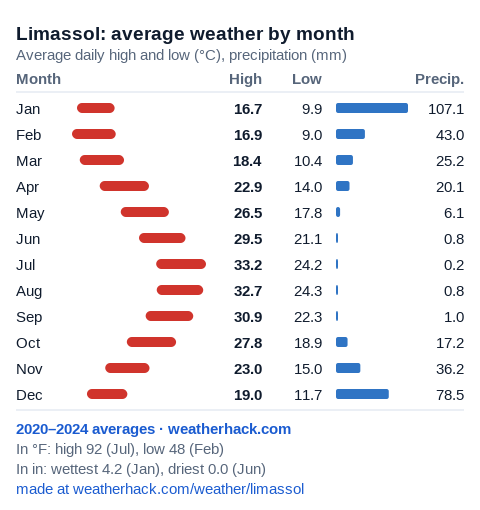
Plain HTML: a picture and a link. No script, no cookies, nothing to install.
Limassol in March — frequently asked questions
Quick answers computed from the same climate normals as the figures above — except the sea-temperature answer, which comes from Open-Meteo's marine model for 2023 and 2024.
What is the weather like in Limassol in March?
In March, Limassol averages an 18.4 °C (65 °F) daytime high and a 10.4 °C (51 °F) overnight low, with about 25.2 mm (1.0 in) of precipitation over the month, roughly 10.5 hours of sunshine a day and relative humidity near 61%. These are 2020–2024 ERA5 monthly averages, not a forecast.
How much does it rain in Limassol in March?
Limassol gets about 25.2 mm (1.0 in) of precipitation in an average March, which is close to the Limassol monthly average (the year averages 28.0 mm (1.1 in) a month). Figures count both rain and melted snow.
How many days does it rain in Limassol in March?
Rain or snow reaches at least 1 mm on about 6.2 days in an average March in Limassol — roughly 20% of days. Counted from daily ERA5 records for 2020–2024; the 1 mm cut-off is the WMO rain-day threshold, so light drizzle is not counted.
What should I pack for Limassol in March?
Cool 18.4 °C (65 °F) days call for a jumper or light jacket. Evenings cool to about 10.4 °C (51 °F), so a light layer after dark is useful. Rainfall is modest at around 25.2 mm (1.0 in) for the month; a packable rain layer is plenty. It falls on about 6.2 days of the month — days recording at least 1 mm, the WMO rain-day threshold — or about 1.0 days of any five you are there. Averaged over those days the rain is moderate: about 4.1 mm (0.2 in) each, a proper shower you will want cover for — though that per-day figure is a ceiling rather than a typical day, since the sub-1 mm days feed the monthly total too.
How warm is it in Limassol at 8 pm in March?
At 8 pm: usually about 14 °C (57 °F) in March, against an average high of 18.4 °C (65 °F) and low of 10.4 °C (51 °F). For dinner outside, a real jacket rather than just a sweater, if you will sit outside for long. It is the mean of every 20:00 local time (Asia/Nicosia, following daylight saving) in March 2020–2024, from hourly ERA5 temperatures in the Open-Meteo historical weather archive for the grid cell covering Limassol — not a forecast: single evenings run several degrees either side, and a sheltered terrace feels warmer than an open, breezy spot.
Is March a good time to visit Limassol?
March is a middling choice for Limassol, ranking 7th of 12 on our comfort score, with a mean daily temperature around 14.4 °C (58 °F). It uses the same comfort score as our best-weather rankings — it rewards a mild 18–24 °C mean daily temperature and lightly penalises rain, and it ignores humidity, wind, daylight and crowds, so treat it as a data-driven starting point rather than a verdict.
How windy is Limassol in March?
The sustained 10-metre wind in Limassol averages 5.9 m/s (21 km/h / 13 mph) in March, the same figure quoted higher up this page. That average is taken over the highest sustained reading of each day, so most hours of a typical March day sit below it rather than at it. Gusts are a separate number: a windy March day peaks near 12.2 m/s (44 km/h / 27 mph), which is a short peak inside the wind rather than a speed it holds for hours. Both figures are 2020–2024 ERA5 monthly averages for the reanalysis grid cell covering Limassol, not a forecast: an exposed waterfront, ridge or open plaza runs windier than the cell average, a sheltered street runs calmer, and single days vary far more than a five-year mean can show.
How humid is Limassol in March, and how muggy does it feel?
Relative humidity in Limassol averages about 61% through March, for a mean dew point of 6.5 °C (44 °F) — the same figures quoted higher up this page. Mugginess follows the dew point rather than the percentage, because relative humidity is measured against the air temperature and the same percentage feels nothing alike on a cold morning and a hot afternoon. On the band this page states — a dew point above 20 °C feels oppressive, 16–20 °C feels humid and sticky, 10–15 °C is comfortable, and below 10 °C feels dry — March in Limassol is dry: the air feels dry and the heat feels lighter than the thermometer suggests. Both are 2020–2024 ERA5 monthly means for the reanalysis grid cell covering Limassol, averaged over every hour of the month rather than over muggy afternoons alone, so a humid spell runs above these figures and a dry one below them.
How strong is the sun in Limassol in March?
Across March, the mean of the daily maximum UV index in Limassol is 4.9, averaged over 2023 and 2024. That is an average of each day’s highest reading, which normally falls around solar noon, so a cloudless March day here runs above 4.9 and an overcast one below it — the figure is a mid-day peak averaged over days, not a level the sun holds from morning to evening. Strength is a separate question from how long the sun is up and from how many hours of it get through the cloud: this number says nothing about either. It is CAMS-derived ultraviolet from Open-Meteo for the grid point covering Limassol — a two-year mean, and a different archive from the one behind the temperature and rainfall figures on this page.
How hot and how cold does it actually get in Limassol in March?
Across the 2020–2024 daily observations, the hottest day in March in Limassol reached 29.1 °C (84 °F) and the coldest night fell to 2.7 °C (37 °F) — a five-year observed range, not the extreme of a longer history. Those are two single days out of five years of March, so a typical March sits well inside them: the averages above are an 18.4 °C (65 °F) daytime high and a 10.4 °C (51 °F) overnight low. Both edges come from daily ERA5 values for the reanalysis grid cell covering Limassol rather than from a station thermometer in the city, so a sheltered courtyard or an exposed hilltop within the same city can read warmer or colder than either figure.
How long are the days in Limassol in March?
In the middle of March the day itself — sunrise to sunset — lasts 12 hours in Limassol. Day length is set by latitude and the tilt of the Earth, so this is computed for Limassol’s latitude at mid-month, not measured: it reads no weather data, and cloud, rain or heat cannot change it. It is a mid-month sample rather than an average of the whole month: near the solstices the length barely moves across four weeks, while near the equinoxes a mid-latitude city gains or loses two to three minutes a day, so the ends of March can sit roughly half an hour either side of this figure. It is also not the sunshine figure: the 10.5 hours a day quoted above are a modelled estimate of how much of that day the sun actually gets through, which is always the smaller number.
What time does it get dark in Limassol in March?
In Limassol the sun sets at 17:43 on 1 March 2027, 17:55 on 15 March and 19:08 on 31 March, and it rises at 06:18 on 1 March, 05:59 on 15 March and 06:37 on 31 March. These are local clock times, summer time included (UTC+2 on the 1st, UTC+2 on the 15th, UTC+3 on the 31st). Clocks go forward one hour on Sunday 28 March 2027, which moves both times one hour later from that date — the clock, not the sun. They are computed with the NOAA solar equations for the sun's upper edge on a flat sea-level horizon, not observed: hills or tall buildings can hide the sun a few minutes before the sunset time, and it is not fully dark until twilight ends after it.
How much does March in Limassol vary from year to year?
Across 2020–2024 the average daytime high for March in Limassol ran from 15.0 °C (59 °F) in its coolest year to 21.2 °C (70 °F) in its warmest — five annual values of a monthly mean daily high, one per year, not five individual days. The gap between the coolest and the warmest of those five is 6.2 °C (11 °F), so the 18.4 °C (65 °F) average quoted above is a middle the individual years sit either side of rather than a figure any one March actually landed on. That gap is how much weight the average deserves: a month whose five years agreed to within a degree is a far safer thing to plan a trip around than one that swung four, and this March swung 6.2 °C. Each of the five is a whole March averaged, from daily ERA5 values for the reanalysis grid cell covering Limassol — it is the month as a unit moving between years, not the day-to-day scatter inside any one of them.
How warm is the sea in Limassol in March?
The sea off Limassol averages 17.9 °C (64 °F) through March, measured at the nearest ocean grid point about 6.0 km from the city: a modelled sea-surface temperature averaged over the two years 2023 and 2024, from Open-Meteo's marine model rather than the land archive behind the temperature, rainfall and wind figures on this page. Treat it as the typical surface water for the month as a whole, not as the reading you would get wading in off a particular beach on the day you arrive. For scale inside Limassol's own year: the sea is warmest in August at 28.6 °C (83 °F) and coolest in February at 17.3 °C (63 °F), which puts March about 10.7 °C below the warm end and 0.6 °C above the cool end.
Limassol weather in other months
- January — avg high 16.7 °C (62 °F), low 9.9 °C (50 °F)
- February — avg high 16.9 °C (62 °F), low 9.0 °C (48 °F)
- March
- April — avg high 22.9 °C (73 °F), low 14.0 °C (57 °F)
- May — avg high 26.5 °C (80 °F), low 17.8 °C (64 °F)
- June — avg high 29.5 °C (85 °F), low 21.1 °C (70 °F)
- July — avg high 33.2 °C (92 °F), low 24.2 °C (76 °F)
- August — avg high 32.7 °C (91 °F), low 24.3 °C (76 °F)
- September — avg high 30.9 °C (88 °F), low 22.3 °C (72 °F)
- October — avg high 27.8 °C (82 °F), low 18.9 °C (66 °F)
- November — avg high 23.0 °C (73 °F), low 15.0 °C (59 °F)
- December — avg high 19.0 °C (66 °F), low 11.7 °C (53 °F)
← Full Limassol forecast & climate · Best weather in March (all cities)